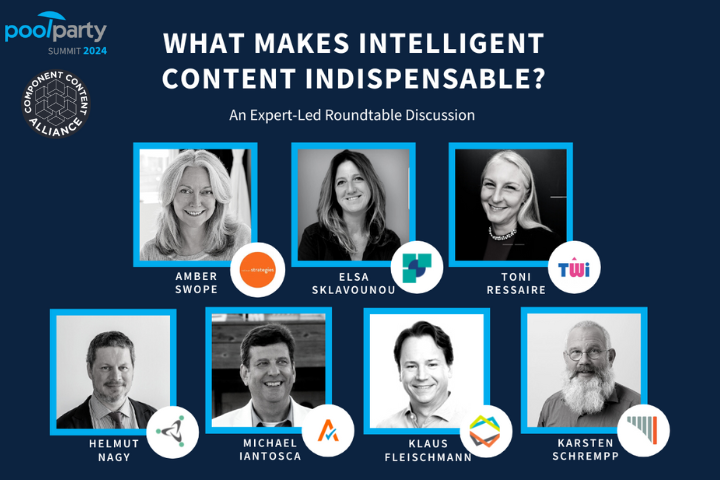
In March 2024, I participated in a roundtable at PoolParty Summit 2024, hosted by the Semantic Web Company. The session was moderated by Elsa Sklavounou, Vice President AI Alliances and Global Partnerships at RWS, and organized through the Content Component Alliance. The other panelists were Karsten Schrempp of PANTOPIX, Klaus Fleischmann of Kaleidoscope, Michael Iantosca of Avalara, Toni Byrd Ressaire of Technically Write IT, and Helmut Nagy of Semantic Web Company.
The discussion opens with definitions and quickly gets specific. Intelligent content is content that can have a life of its own — designed to be delivered into different contexts and to perform as designed when it gets there. That requires both structure and intent. A framework is not a set of templates; it is a defined space where content is written by purpose, and purpose comes from understanding who you are serving and what they are trying to achieve.
The analogy I like to use is electrical wiring: when you walk into a room and flip a light switch, you expect the lights to come on. That only works if someone planned the wiring first. Most organizations are in reactive mode, creating content on demand without that architecture in place.
The conversation covers a lot of ground — terminology as the foundation of any knowledge graph, why RAG models alone cannot deliver reliable AI results without structured content underneath them, what change management looks like when AI is inserted into a content operation that was never designed to accommodate it, and how to get from content silos that can't be eliminated to content silos that can be bridged through standards, governance, and shared terminology.
The panel arrives at a conclusion I find useful: the problem most organizations are about to face with generative AI is not a programming problem. It is a knowledge problem. Developers are shovel-loading content into systems without anyone asking what happens when that content changes, who owns the update cycle, or whether the content was structured well enough to support accurate retrieval in the first place. The organizations that will get reliable results are the ones who built the architecture before the urgency hit.
Watch the full roundtable to hear how practitioners across the intelligent content space are thinking through these decisions.
If your organization is building AI-powered tools and running into accuracy or consistency problems — or if you are about to start and want to avoid them — the question is usually about content architecture, not the AI itself.
Book a free discovery call to talk through what your content infrastructure needs to support before you build on top of it.
Recorded at PoolParty Summit 2024, hosted by Semantic Web Company. Moderated by Elsa Sklavounou of RWS. Panelists: Karsten Schrempp (PANTOPIX), Klaus Fleischmann (Kaleidoscope), Michael Iantosca (Avalara), Toni Byrd Ressaire (Technically Write IT), and Helmut Nagy (Semantic Web Company).
The Breaking Barriers panel covers the same "almost right" problem from a practitioner angle — what happens when content quality isn't accounted for before AI goes live.
The practitioner case study documents what AI-ready content architecture looks like in a real implementation, including a practical checklist.