How to Work with Your Agent of Change
Dan Schommer and I gave this presentation at ConVEx 2025.
TABLE OF CONTENTS
Love Your Agent of Change: Embracing Your Partner in Transformation
This presentation is the follow-up to a session Dan Schommer and Lief Erickson (in my stead) delivered the previous year called Love Your Curmudgeon, which explored how teams can unlock value in their most resistant members. After that session, people came up to them and asked the reverse question: what about the person on the other end of the spectrum — the one who shows up with big ideas, boundless enthusiasm, and a mandate to change everything? This is that conversation. Here, Dan and I look at agents of change from both directions: if you are one, what mistakes are you probably making? If you work alongside one, what does constructive engagement look like? The scenarios we walk through are drawn from real situations we have encountered across combined careers that add up to well over 50 years. The goal is not to assign blame but to close the gap between the person driving change and the team it lands on.
Who We Are
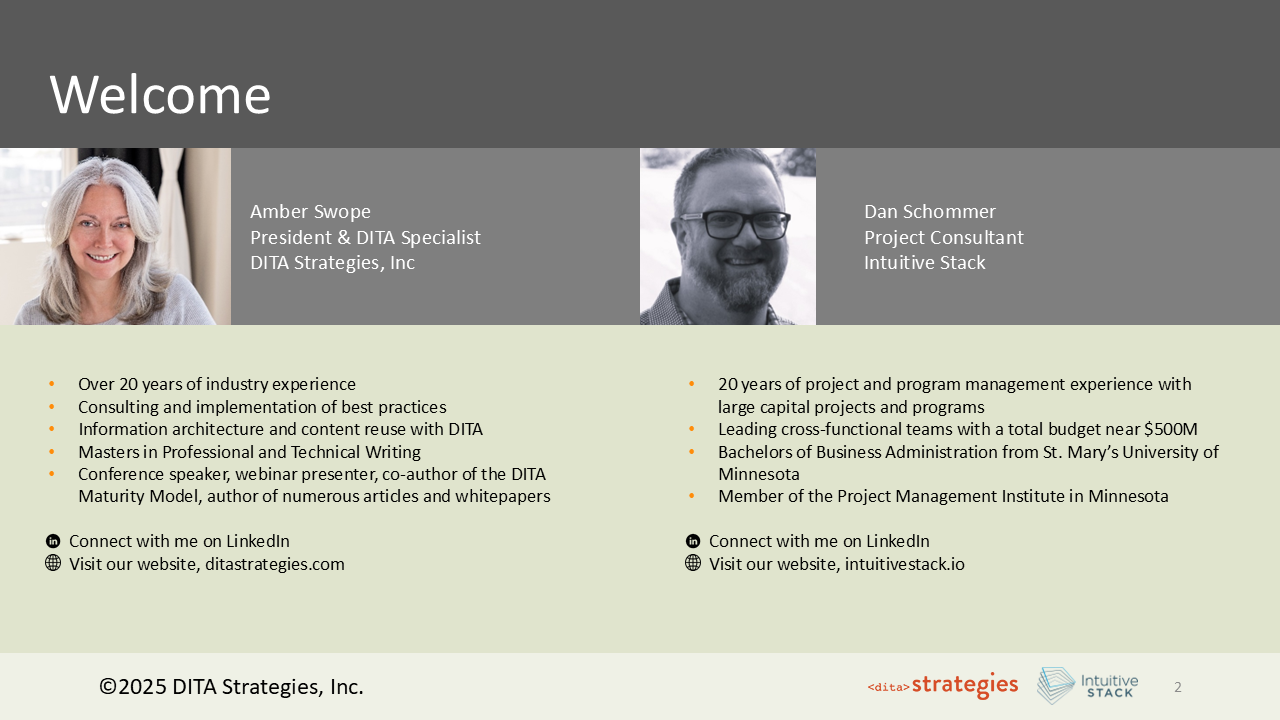
Dan Schommer is a project consultant with Intuitive Stack, bringing more than 20 years of experience leading cross-functional teams on large capital projects and programs with a total budget near $500 million. He holds a Bachelor of Business Administration from St. Mary's University of Minnesota and is a member of the Project Management Institute in Minnesota. I am Amber Swope, President and DITA Specialist at DITA Strategies, Inc. My work focuses on information architecture and content reuse with DITA. I am a conference speaker, webinar presenter, co-author of the DITA Maturity Model, and author of numerous articles and whitepapers. Dan and I have collaborated on client engagements and conference presentations for several years, and this talk grew directly out of that shared experience.
By Popular Request

This session exists because people asked for it. After Dan and I delivered Love Your Curmudgeon at ATX Minneapolis, attendees approached us with a specific question: what about the agent of change? It did not occur to us, frankly, that agents of change could be the disruptive ones — Dan and I are both agents of change, and we tend to see that as a feature. But the request was legitimate. There is a real tension between the person tasked with driving transformation and the team living through it. Naming that tension honestly is the starting point for working through it. That is what this presentation is built to do.
How to Spot an Agent of Change
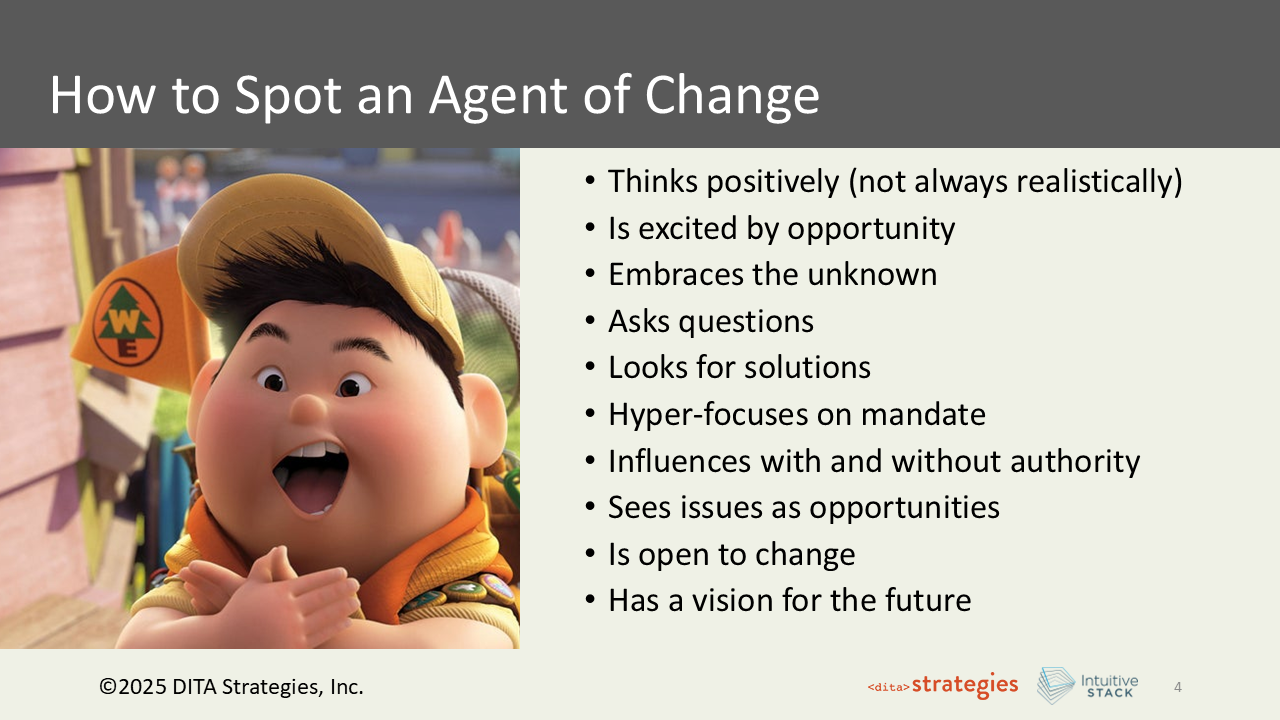
Agents of change share a recognizable set of characteristics. They tend to think positively — sometimes more positively than the situation warrants. They are energized by opportunity and comfortable with ambiguity. They ask questions and look for solutions rather than cataloging obstacles. They often have a mandate to make change happen, but authority does not always accompany that mandate. An agent of change may influence without formal power — much like a curmudgeon, who also influences without authority, just in a different direction. What distinguishes an agent of change is a forward orientation: they are looking at what the team or organization could become, sometimes at the expense of understanding where it currently is. That gap between future-focus and present-reality is where most of the friction in these scenarios originates.
What Motivates an Agent of Change
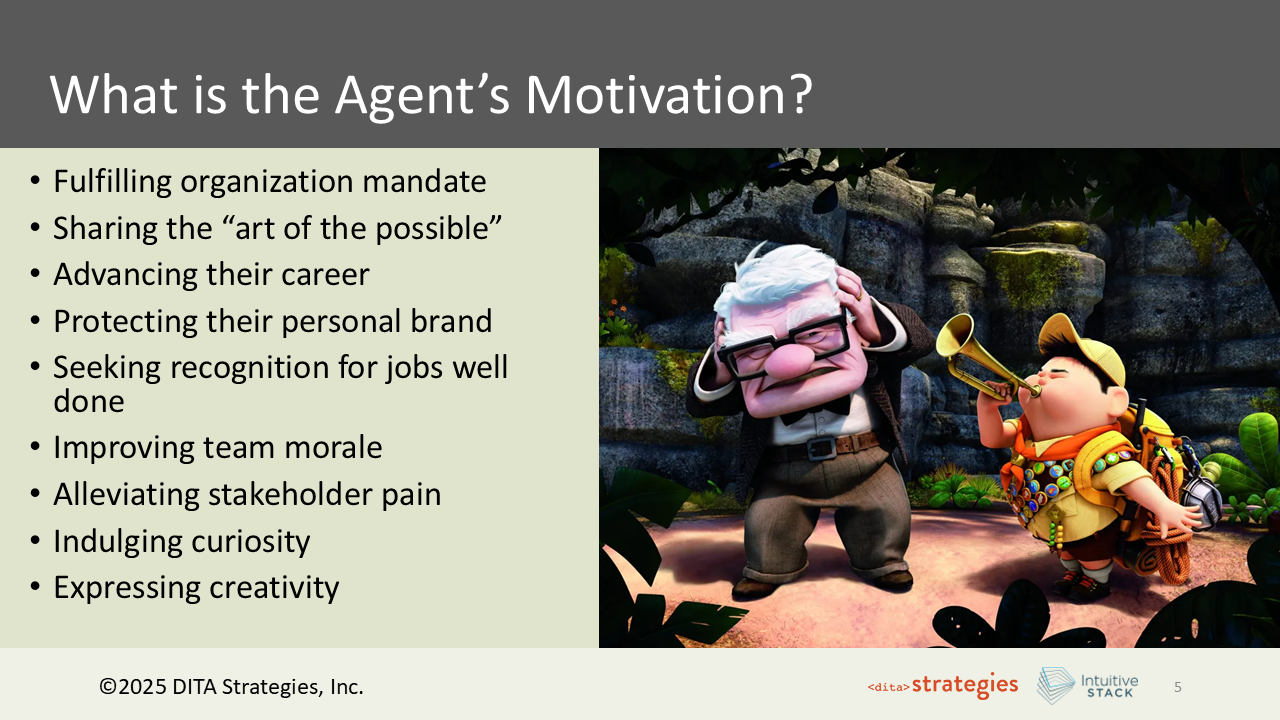
Understanding motivation matters because it shapes how an agent of change communicates and where their blind spots tend to cluster. The motivations we have seen — in ourselves and in clients — include fulfilling an organizational mandate, sharing a vision of what is possible, advancing a career, protecting a personal brand, earning recognition, improving team morale, alleviating pain for stakeholders, satisfying curiosity, and expressing creativity. Underneath most of these is something Dan and I came to call stewardship — not stewardship of the current state, which is more characteristic of a curmudgeon, but stewardship of the future. Agents of change feel a responsibility for where the team is headed. That sense of responsibility is genuine and often valuable. It also makes it easy to push too far, too fast, in ways the team is not ready for.
Scenario 1: New Authoring Tool Adoption — The Proposal
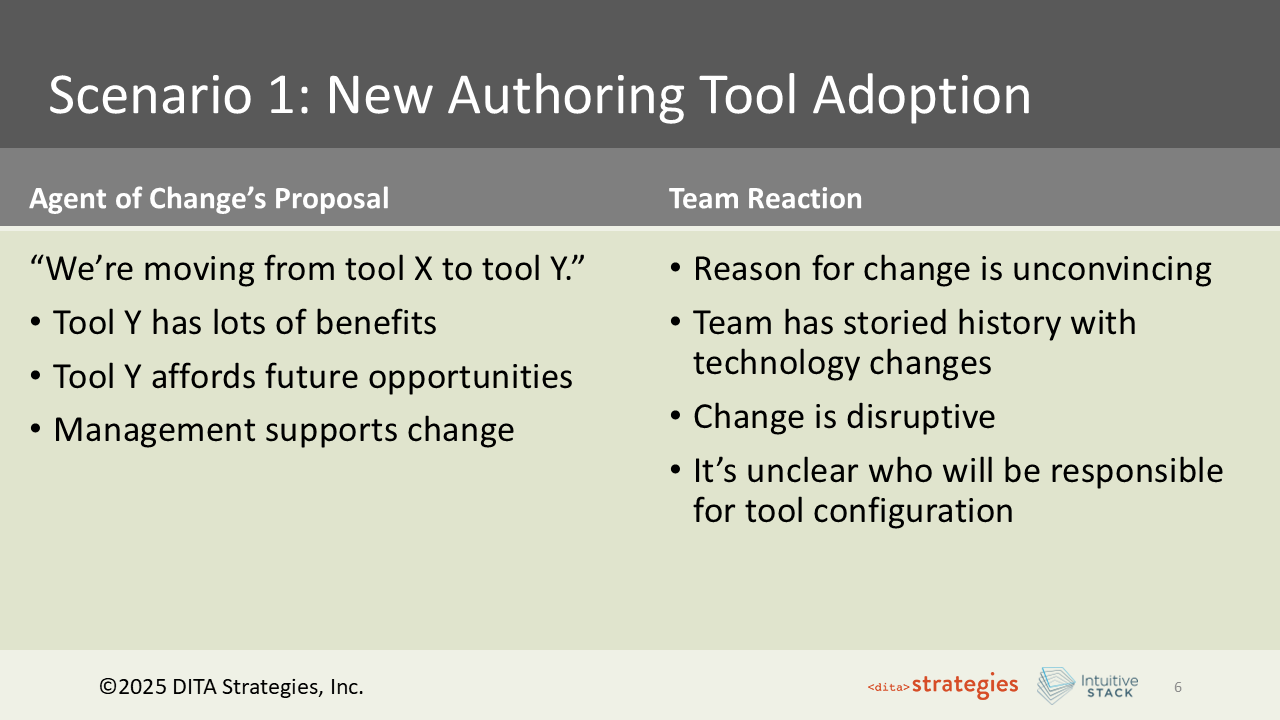
In the first scenario, the agent of change comes to the team with a tool migration proposal. The pitch: we are moving from tool X to tool Y. Tool Y has significant benefits. It opens up future capabilities. Management is on board. The team's reaction is more complicated. The reason given for the change does not feel convincing. The team has lived through technology changes before — changes that were promised as improvements and did not deliver. They are aware of who will be responsible for configuring the new tool, and that question has not been answered. The disruption feels real and the payoff feels theoretical. This is a pattern that repeats across all four scenarios: the agent of change is looking at what could be, while the team is looking at what has happened before and what it costs to get there.
Scenario 1: Blind Spots and Team Strategies
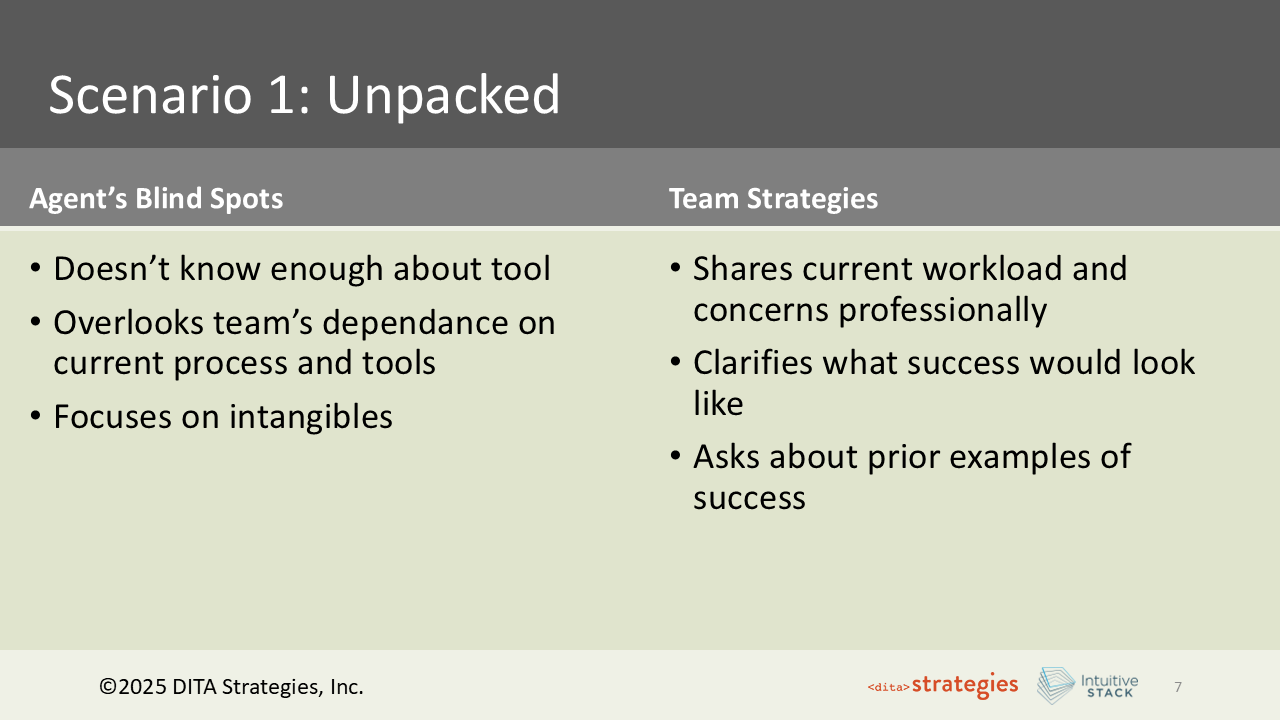
The agent of change in this scenario has a few significant blind spots. They may not know enough about the tool to make a credible case. They are overlooking the team's investment in current processes and tools — time spent building workflows, workarounds, and expertise that is not visible in the proposal. And they are leading with intangibles: this will be great, this will open up possibilities. What success actually looks like for the team has not been defined. The team, for their part, has constructive options. They can share their current workload and concerns professionally rather than reactively. They can ask the agent of change to define what success looks like in specific terms. They can ask about prior examples — what worked, what did not, and why. These are not obstructionist moves. They are the information the agent of change needs to make the change work.
Scenario 1: Takeaway
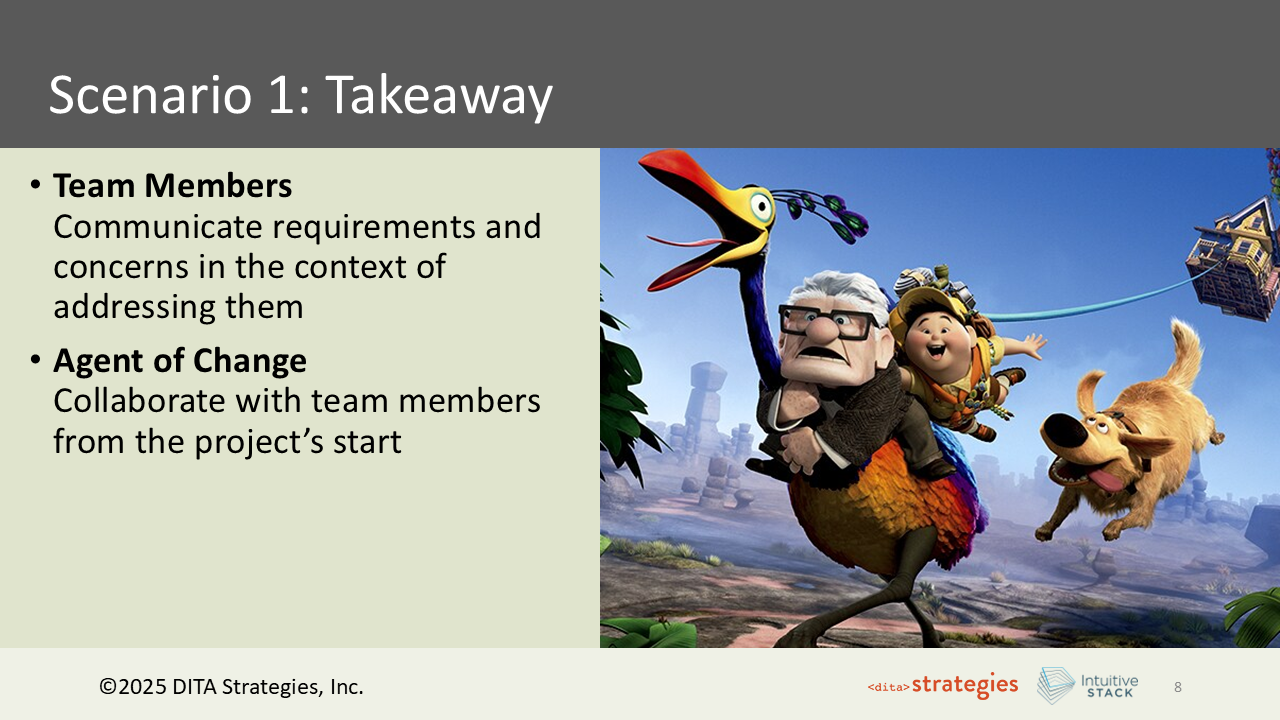
The core takeaway from this scenario applies to both sides. Team members need to communicate their requirements and concerns in the specific context of addressing them — not as objections, but as information. If you are the team and you know the last two tool migrations failed, say why in concrete terms. What did not work, and what would have needed to be different? The agent of change, meanwhile, needs to build collaboration into the project from the start — not as a consultation step at the end, but as the foundation. Getting to know what team members have built, what they depend on, and what they have already tried is not optional groundwork. It is the work.
Scenario 2: Structured Authoring Implementation — The Proposal
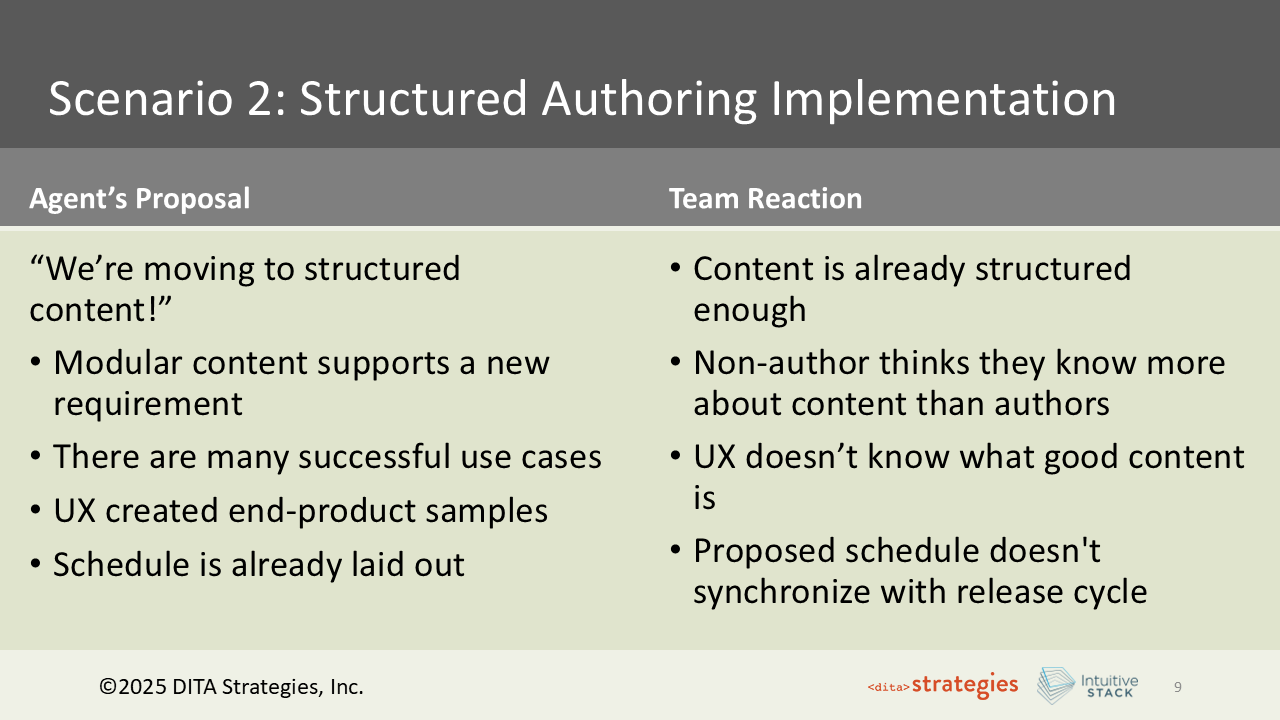
The second scenario involves a move to structured content. The agent of change arrives with a case built around modular content, new delivery requirements, successful use cases elsewhere, UX-produced end-product samples, and a schedule already laid out. The team's reaction is immediate and pointed. Authors who know their content well resist the implication that their current approach is insufficient. UX involvement in a content decision feels like overreach. The use cases cited do not feel relevant to this team's situation. And the proposed schedule does not account for existing release cycles — adding structured authoring work on top of an already full workload is not a plan, it is an additional burden without a corresponding reduction somewhere else. Every element of the proposal that felt like a solution to the agent of change lands as a problem for the team.
Scenario 2: Blind Spots and Team Strategies
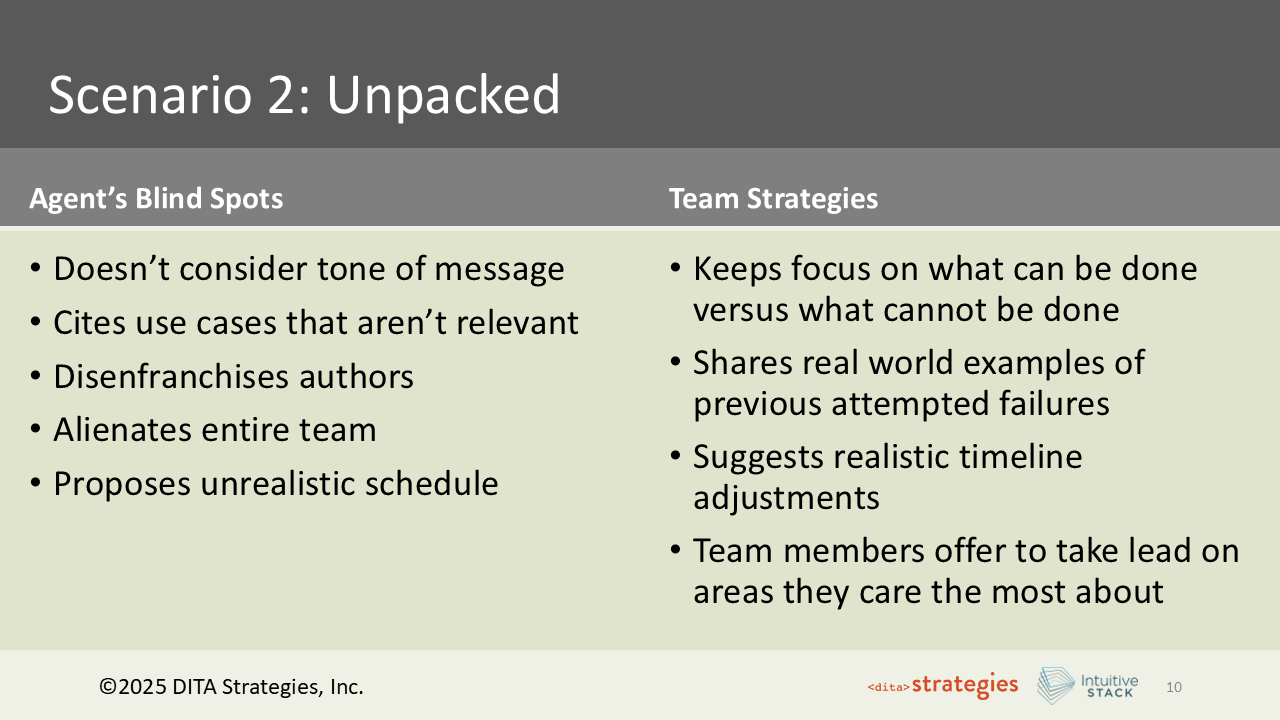
The agent of change here made several compounding mistakes. The tone of the message was not considered — and tone matters. Dan offered a useful frame in the session: if someone hands you a gold bar, you feel great. If they beat you with it, you do not care how valuable it is. Structured content might genuinely transform how this team works. If it is presented in a way that disenfranchises authors or alienates the team, that value does not land. Additionally, citing use cases that are not relevant to this team's context undermines credibility rather than building it. And proposing an unrealistic schedule — one that ignores how the team actually operates — signals that the agent of change has not done the work of understanding the current state. The team's strategies center on keeping focus on what can be done, offering realistic timeline input, and volunteering to lead on the parts of the work they are most invested in.
Scenario 2: Takeaway
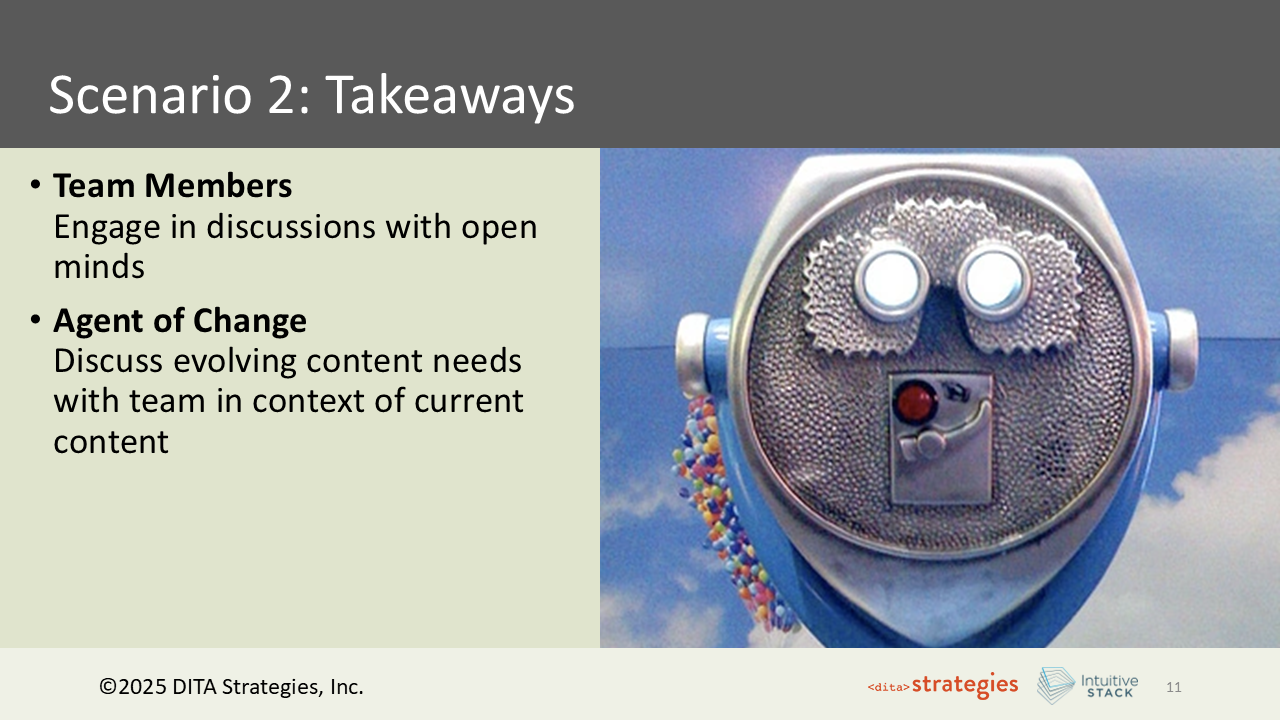
Team members work best when they engage with an open mind and are willing to acknowledge evolving content needs, even when the proposal lands badly. That does not mean accepting an unrealistic implementation plan. It means separating the idea from the execution and engaging constructively with the former while pushing back specifically on the latter. The agent of change, for their part, needs to discuss evolving content needs in the context of what the team is actually producing today. Structured content has a strong case. That case gets stronger, not weaker, when it is grounded in the team's real workflows, delivery requirements, and constraints rather than external benchmarks that may not apply.
Scenario 3: New Success Metrics and KPIs — The Proposal
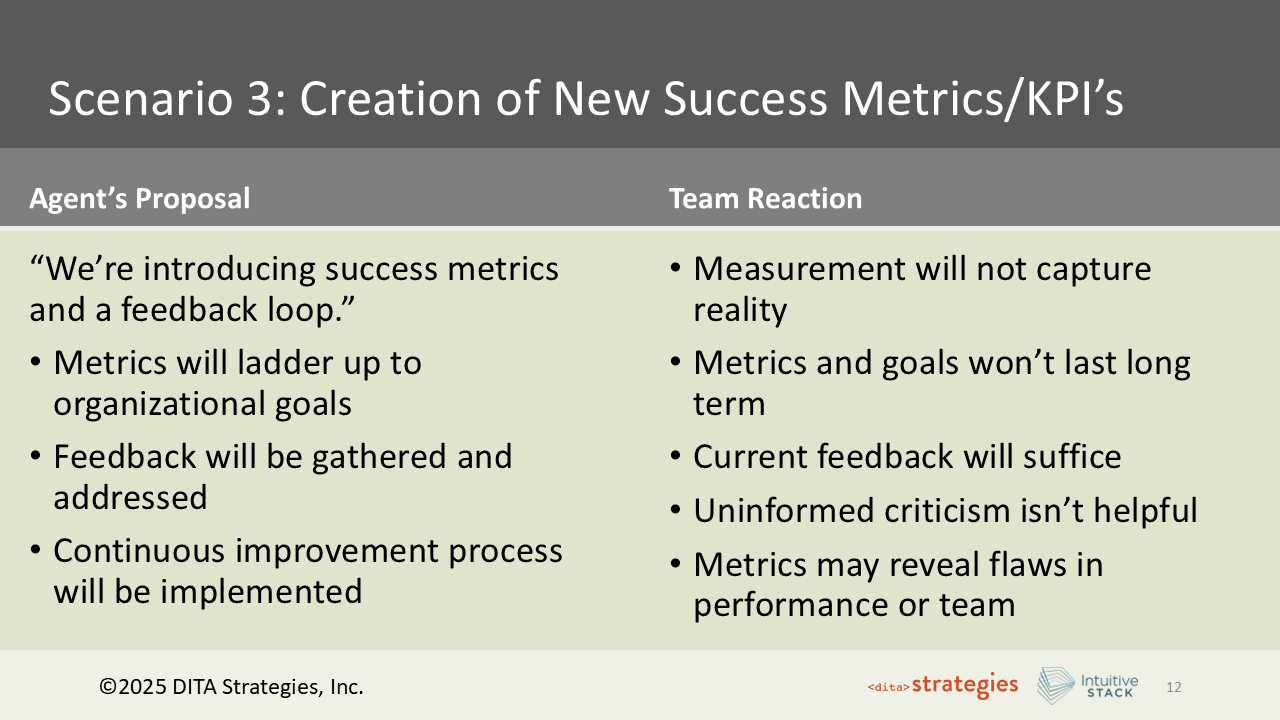
In the third scenario, the agent of change proposes introducing formal success metrics and a feedback loop. The stated benefits are clear: metrics will connect to organizational goals, feedback will be gathered and addressed, and a continuous improvement process will follow. The team's reaction is skeptical on multiple fronts. Measurement, they argue, will not capture how the work actually gets done. Goals defined now will not last. Current feedback mechanisms are sufficient. Uninformed criticism from outside the team is not useful input. And underneath all of it is a concern the slide names directly: metrics may reveal flaws in team performance. When measurement feels like surveillance, the case for it — no matter how well-reasoned — becomes very difficult to make.
Scenario 3: Blind Spots and Team Strategies
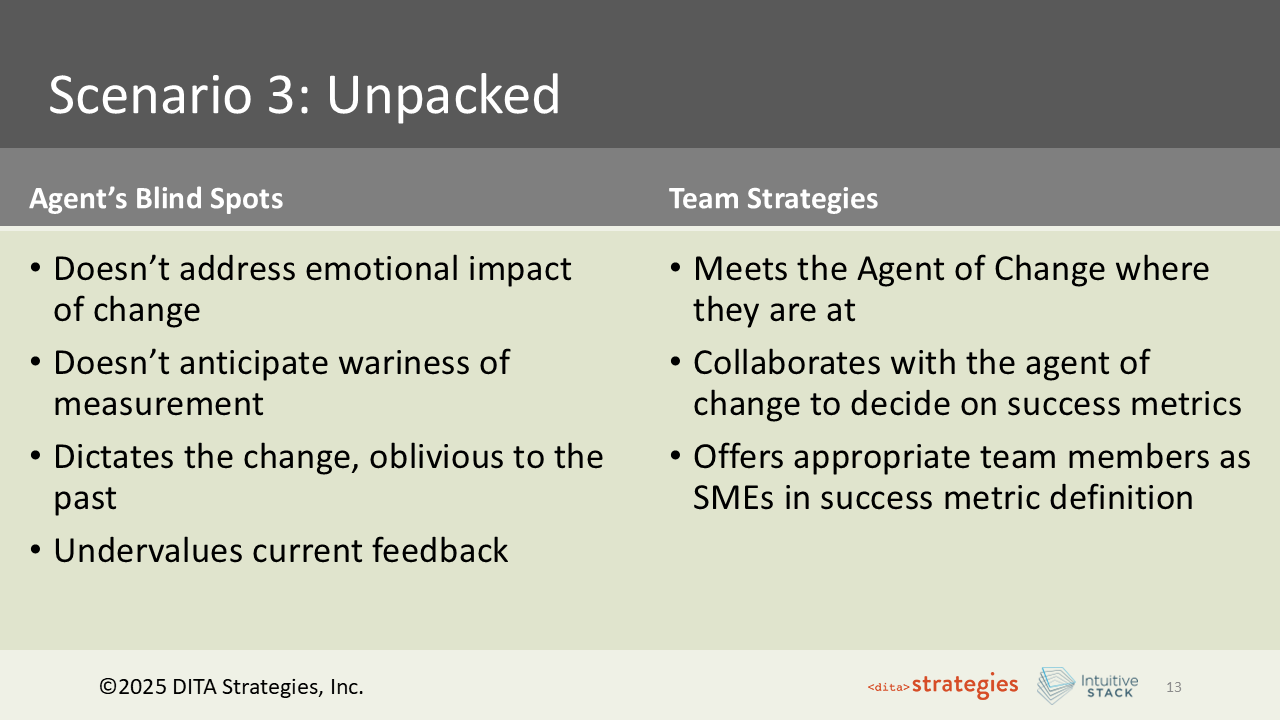
The agent of change underestimated the emotional weight of being measured. Introducing metrics without addressing what it feels like to be evaluated — particularly for a team that has not been asked to define what success looks like — creates resistance that the data alone cannot overcome. The agent of change also dictated the change rather than building it with the team, and undervalued the feedback mechanisms already in place. The team's strategies here are notably collaborative. They meet the agent of change where they are. They offer to co-define success metrics rather than receiving them from above. They bring in the team members who are closest to the work as subject-matter experts in defining what measurement should look like. That is not compliance — it is ownership, and it produces metrics that are more likely to reflect reality.
Scenario 3: Takeaway
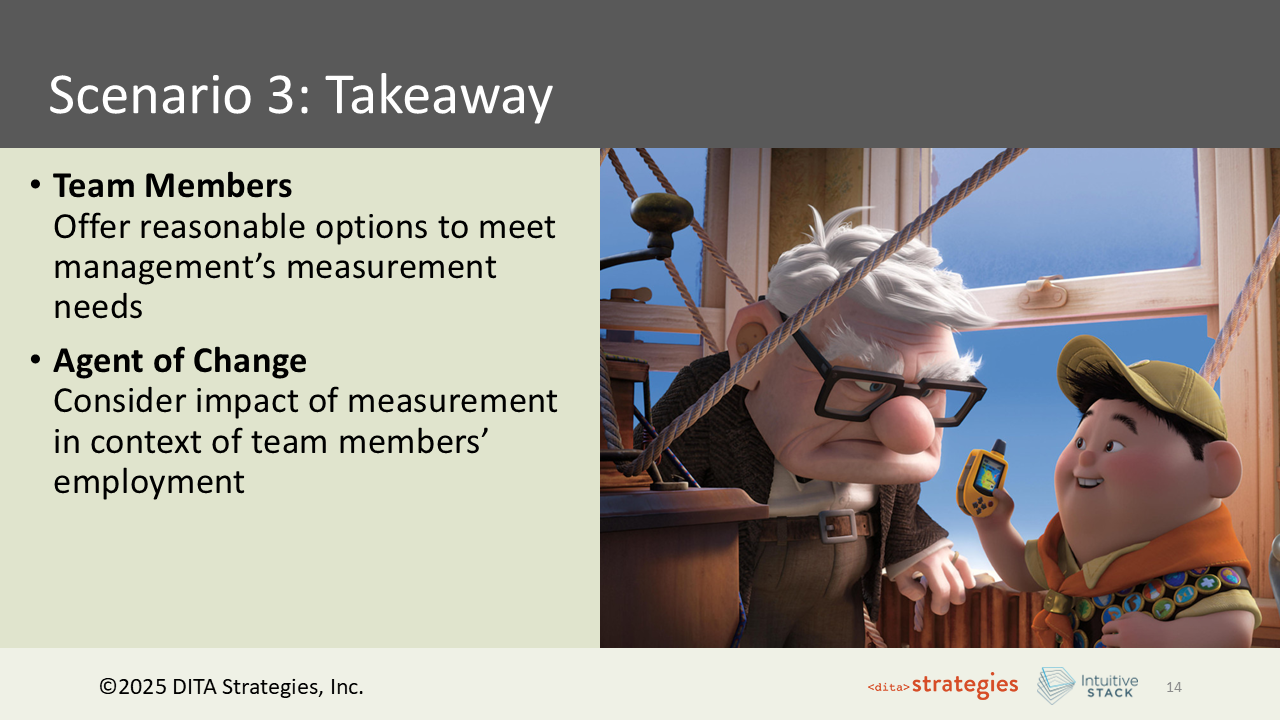
Team members are in a position to offer reasonable options that satisfy the measurement goals leadership has set without imposing metrics that feel disconnected from the actual work. That contribution is valuable and worth making explicitly. The agent of change carries a reciprocal responsibility: to consider the employment impact of measurement, not just the operational benefits. Metrics tied to performance have real stakes for real people. Acknowledging that directly — and designing the measurement process in a way that the team co-owns — is what separates a feedback loop that works from one that generates resentment.
Scenario 4: Adoption of a New Process — The Proposal
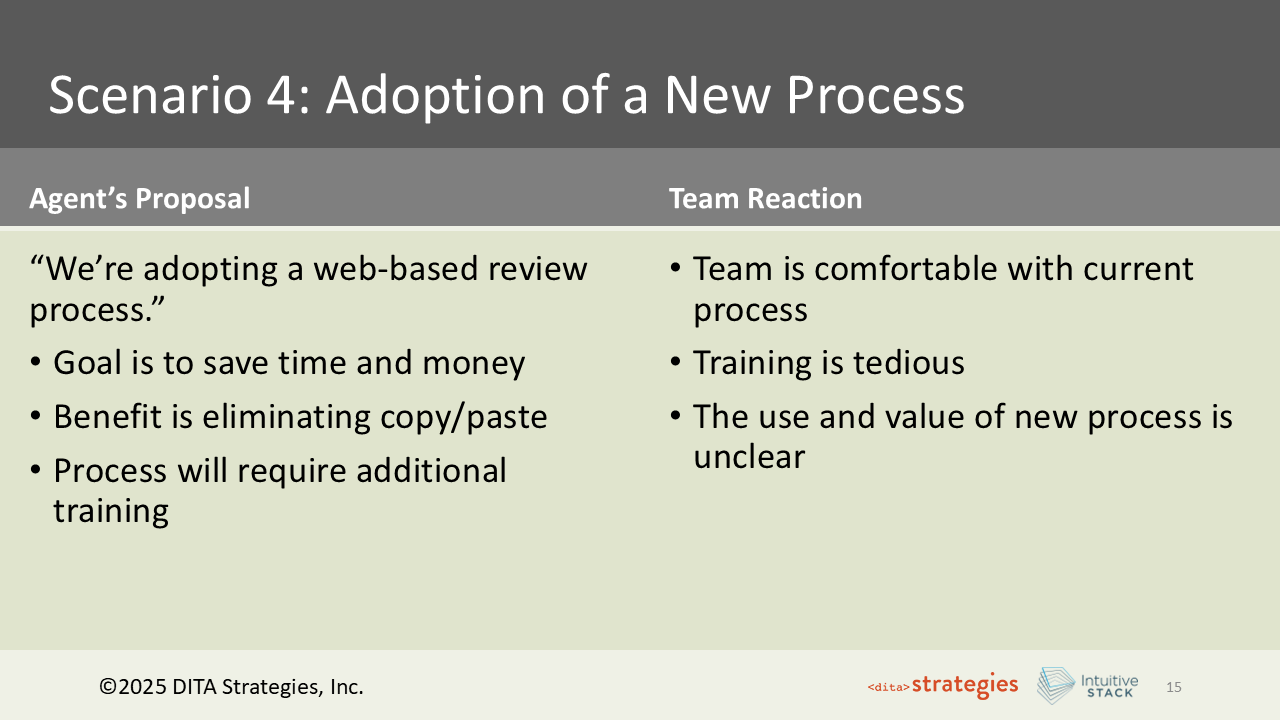
The fourth scenario involves a web-based review process. The agent of change has identified a real problem — the current review process is something the team has complained about — and arrives with a solution. The goals are to save time and money and eliminate the copy-paste friction that exists in the current process. Training will be required. The team's reaction is familiar: comfort with the current process, however imperfect, outweighs enthusiasm for something new. Training takes time and energy. And the value of the new process is not obvious to the people who will have to learn it. Hearing about a problem and solving it are not the same thing. The agent of change heard the complaints, took them at face value, and built a solution — without checking whether the solution addressed the actual source of the pain.
Scenario 4: Blind Spots and Team Strategies
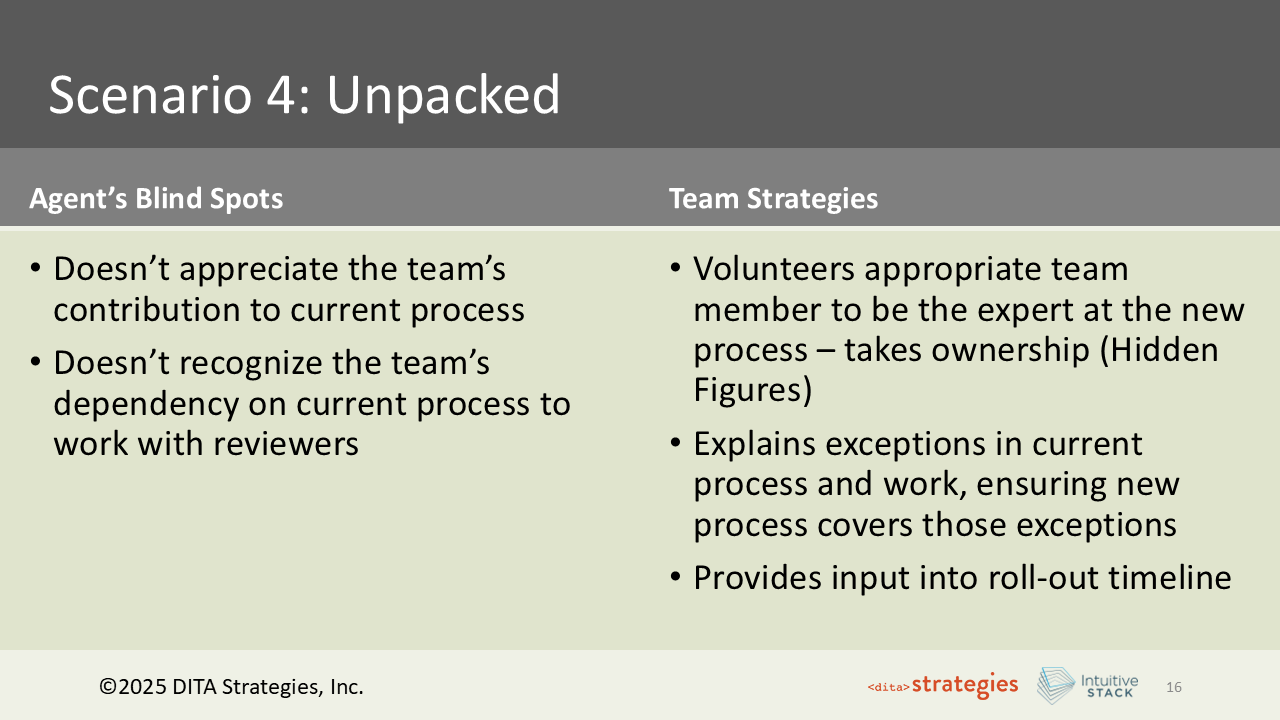
Review processes are more complex than they appear, particularly in regulated industries. Requirements around who can comment, how comments are validated, what approvals are needed, and what documentation a regulatory body requires are not visible in the surface-level complaint. The agent of change did not take the time to distinguish between what the team was venting about and what was actually causing the problem. The team strategy here involves something Dan described using the film Hidden Figures: taking initiative to become the expert at the new process, rather than waiting for it to be imposed. In the film, Dorothy Vaughn does not resist the arrival of IBM computers — she learns how they work and teaches her team, so that their existing skills become an asset in the new environment rather than a liability. That same orientation — treating change as something to engage with rather than endure — is available to any team member willing to take it.
Scenario 4: Takeaway
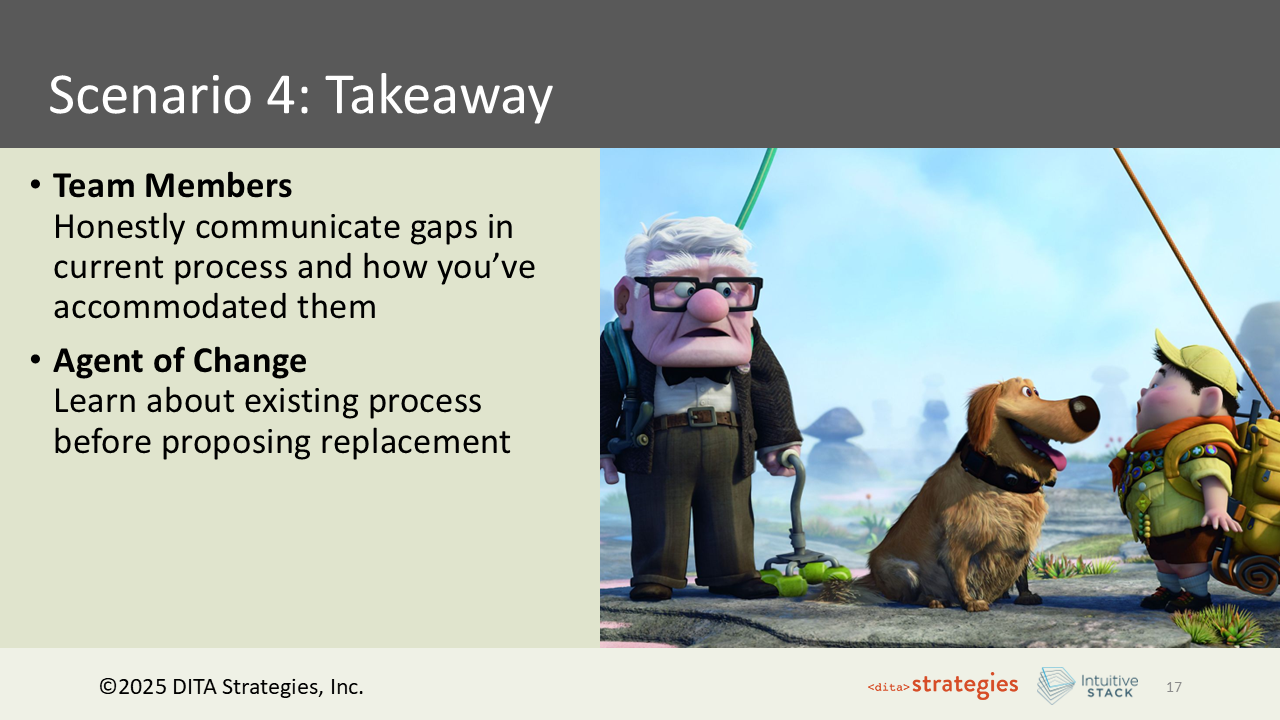
Team members serve themselves and their project by communicating honestly about the gaps in the current process — including the workarounds they have already built to address those gaps. That institutional knowledge is exactly what an agent of change needs and rarely has access to without being told directly.
The agent of change, for their part, should understand the existing process before proposing a replacement. What people complain about is often a symptom. The underlying requirement that created the constraint may be years or decades old, and may no longer apply. Asking what would happen if we simply removed this step — and listening carefully to who responds and how — surfaces the real dependencies faster than any process audit.
Strategy Summary
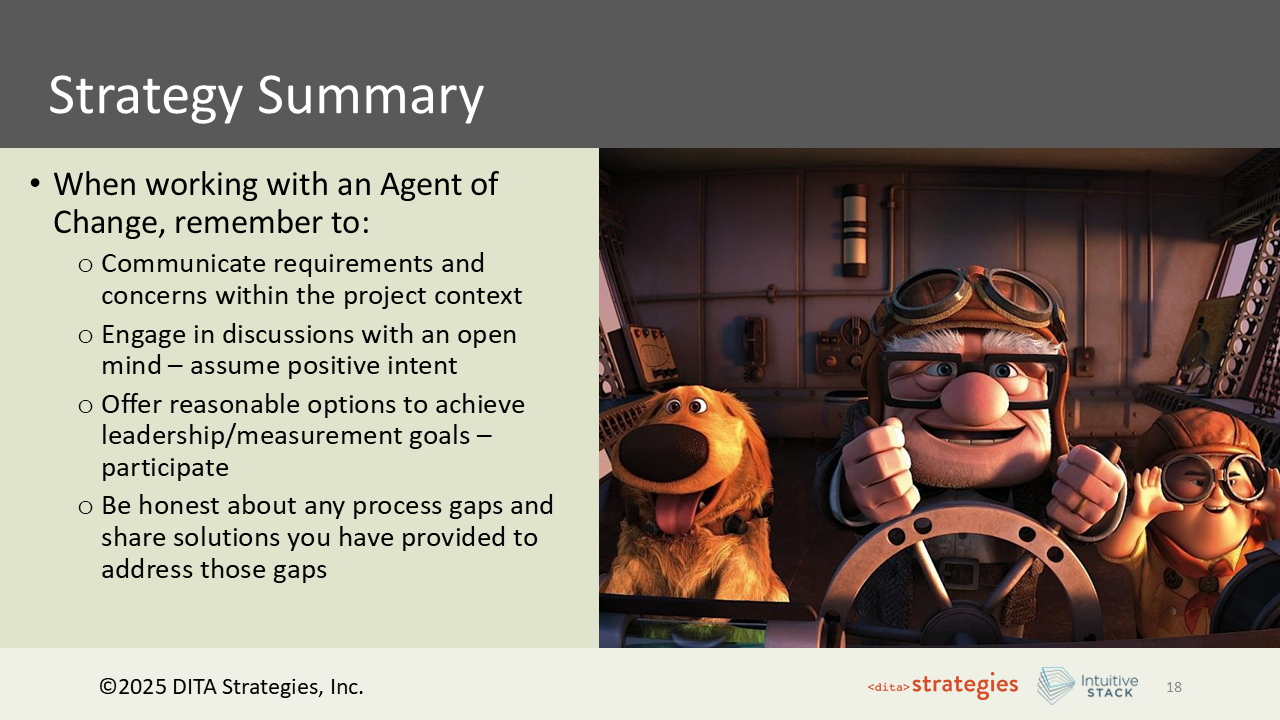
Across all four scenarios, the same four principles emerge on the team member side.
Communicate requirements and concerns in the context of the project — specifically, not generally.
Engage with an open mind and assume positive intent.
Offer reasonable options to meet leadership or measurement goals rather than simply opposing them.
And be honest about the gaps in current processes, including the solutions you have already developed to address them.
Dan and I have both lived through the failure modes we described here. We have been the agents of change who moved too fast, pitched the wrong message, and underestimated what the team already knew. These takeaways are not abstract recommendations. They are what we wish we had done differently — and what we have learned to do since.
If your organization is navigating a content or tooling change and you are trying to figure out how to bring the team along — or how to keep the project from failing before it starts — I would be glad to talk through what that looks like in your specific situation.
Book a free discovery call with Amber Swope.